Canucks Player Grades 2025-2026
- Kyle Welsford
- Apr 21
- 28 min read
Grading Scheme:
A: Exceptional, Fantastic, Great
B: Good, Solid, Quality
C: Average, Ordinary, Meh
D: Bad, Poor, unsatisfactory
F: Terrible, Fail, Insignificant
Player Grades are based on Point Production, Usage, Value In Relation To The Cap, Overall Expectations, and How I Feel
Minimum Requirements:
10+ Games Played
End the season on the Canucks
In order of Games Played
Filip Chytil: C-
Last year’s rank: C
GP 12 G 3 A 0 TP 3 +/- (-7)
Where do you even start with Filip Chytil? The 26-year-old came into this season with something to prove after last year's concussion nightmare cut his Canucks debut to just 15 games. The hope was that a full offseason would reset things, and he'd finally get a chance to show what he could do in Vancouver. For one night, it looked like that was exactly what was happening. He scored twice in the opener against Calgary, looked explosive, and had the tools on full display. Then it all fell apart again.
A hit from Tom Wilson on October 19th against Washington sent Chytil to the sidelines until mid-January. He returned, played six games, and was done again after departing Vancouver's matchup against the Utah Mammoth on February 2nd. Then, just as he was working his way back from that, a deflected puck in practice on February 18th fractured his face. Three major health setbacks in one season. The bad luck was hard to fathom.
Canucks president Jim Rutherford didn't mince words, calling it a very serious situation and raising real questions about what comes next for Chytil. That's a sobering place to be for a player who still has one year left at $4.437M AAV.
The talent is real. The speed is real. But Chytil has now played just 27 games across two seasons as a Canuck, and at some point, the injury history starts to become hard to ignore. Chytil has dealt with concussion after concussion throughout his career, and no contract, no roster spot, and no season is worth compromising his long-term health. Personally, I think retirement is the right call. That said, Chytil clearly doesn't feel that way, as he was spotted participating in practices late in the season, apparently determined to give it another shot.

Jonathan Lekkerimaki: C
Last year’s rank: C+
GP 13 G 2 A 1 TP 3 +/- (-3)
The story of Jonathan Lekkerimäki this season is a familiar one. Dominant in the AHL, invisible in the NHL, and eventually hurt. The 21-year-old, 15th overall pick is caught in a frustrating in-between, too good for the minors, not yet trusted at the top level.
His AHL numbers were impressive. In 21 games with Abbotsford, he put up 13 goals and 20 points, numbers that scream NHL-ready offensive talent. The shot is the best in the system, and maybe even the best on the entire roster. He's fast, he's smart, and he finds space in ways that not many players his age can. When he gets time and room, he's dangerous. The problem is that he rarely gets either at the NHL level.
In 13 games with Vancouver, he managed just 3 points and averaged a shade over 12 minutes a night. That's actually less ice time than last season, which is a strange decision on a team that was firmly in tank territory. When you're losing anyway, why not let your young guns play through their growing pains? Adam Foote needs to do a better job of utilizing him. Lekkerimäki belongs on the first power play unit, no debate, and he needs linemates who can actually get him the puck. Pair him with Elias Pettersson or Marco Rossi and watch what happens.
The elephant in the room is the injury. A season-ending shoulder surgery in February marks his third injury in the last four years. That's a concern that's hard to brush off. He's slight, gets bumped off pucks too easily, and adding strength has to be the number one priority this offseason. The skill is not in question. The durability is.
When healthy and properly deployed, Lekkerimäki is a power-play weapon and a future top-six winger. The Canucks just have to actually give him the chance to prove it.

Curtis Douglas: C+
Last year’s rank: N/A
GP 14 G 1 A 1 TP 2 +/- (-4)
Curtis Douglas was not part of the plan. The Canucks snagged the 26-year-old off waivers from Tampa Bay on March 6th, a depth move on a team that had long since shifted its focus to the offseason. What they got was a 6'9", 242-pound centre from Oakville, Ontario, who immediately made opposing players think twice about taking liberties with Vancouver's young roster.
Averaging just 8:22 a night, Douglas wasn't being asked to quarterback a power play or drive offensive zone time. He was asked to show up, be physical, and protect his teammates. He delivered on all three. Thirty-two hits in 14 games at that kind of ice time is impressive, and the tone around the team shifted the moment he arrived. Fights went up, and the young guys had somebody watching their backs.
Scoring his first career NHL goal was the cherry on top. Watching the entire bench light up for him said everything about the kind of guy Douglas is in that locker room. That moment alone made the waiver claim worth it.
Douglas will be a UFA this summer, and bringing him back on a cheap contract during a rebuild is a no-brainer. The league notices when a team has a 6'9" heavyweight in the lineup, and for the young players coming up, that kind of protection is invaluable.

Thatcher Demko: C
Last year’s rank: C
GP 20 GAA 2.90 SAV .897 SO 1
And we're back. For the third straight season, the main headline surrounding Thatcher Demko is injuries. He came in this year with a full offseason under his belt and genuine optimism surrounding his health, and for the first seven games of the season, that optimism looked completely justified. Demko posted a .926 save percentage to start the year, looking every bit the goaltender that had this city buzzing two seasons ago. When Demko is at his best, he is the best player on this roster, and with Quinn Hughes no longer here, that case is easier to make than ever. The problem is that his best has become increasingly hard to rely on.
Over his final 13 games, the save percentage dropped to .874, and it wasn't hard to see why. A lower-body injury cost him most of November and all of December. He returned, gutted through it, but was clearly compensating. He was pulled after just 20 minutes of a 5-0 loss in Toronto on January 10th and never returned. On January 27th, GM Patrik Allvin announced Demko would undergo hip surgery and miss the rest of the season, noting the injury was unrelated to last year's issues. Though in the same breath, he acknowledged Demko had been compensating for a while, the discomfort moving from one area to another. Make that make sense.
The Canucks signed him to a three-year, $25.5 million extension at $8.5M AAV on July 1st, 2025, a contract that doesn't even kick in until next season. It is a significant commitment for a goalie who has struggled to stay healthy, but with Vancouver carrying considerable cap space, the contract is far from crippling. Realistically, expect Demko to ease back in somewhere in the 30 to 35 game range next year, with the Canucks likely carrying three goaltenders on the roster to keep things covered.
The best ability is availability, and Demko simply cannot stay healthy. But when he's on, there isn't a better player in a Canucks uniform.

Nikita Tolopilo: C
Last year’s rank: N/A
GP 21 GAA 3.61 SAV .881 SO 0
The numbers look rough. They always do when you're playing behind one of the worst defensive teams in the league. Nikita Tolopilo's first real taste of NHL action this season deserves a lot more context than a 3.61 GAA and a .881 save percentage can provide.
The 26-year-old from Minsk, Belarus, is a big body at 6'6" and 229 pounds, and anyone who watched him closely this season knows the stats don't tell the full story. Night after night, he faced a barrage of high danger chances with very little defensive structure in front of him. The Canucks had little to no chance on most of those nights, but Tolopilo's compete level never wavered. That kind of mental toughness in your first extended NHL run is encouraging.
Tolopilo has been quietly developing in the Canucks system for a couple of seasons now, putting together solid AHL numbers in Abbotsford in prior years before earning his shot. A capable backup is likely the ceiling here, and that's not a knock; that's just the reality of what he is. Every team needs one, and at $775K, he's about as team-friendly as it gets.
He has one more year left on his deal, and his role next season could expand considerably depending on how Demko's hip recovery goes and whether Lankinen can rediscover his early-season form. Don't be surprised if Tolopilo finds himself as the de facto number two next season. The opportunity is coming.

Victor Mancini: C
Last year’s rank: C+
GP 24 G 0 A 3 TP 3 +/- (-12)
Victor Mancini is a player you want to like. The 23-year-old right-handed defenseman has the size, the skating, and the physical tools that teams covet on the blue line. A fifth-round pick by the Rangers in 2022, he came to Vancouver as part of the J.T. Miller trade and has been trying to establish himself ever since. This season was a step forward in some ways and a step back in others.
The first 19 games were rough. Pointless, a minus in the double digits, and at times looking genuinely lost in his own end. Foote's defensive system was a problem for a lot of players this season, and Mancini was no exception. He did pick up 3 points in his final 5 games before being a healthy scratch for the last three of the season, not because he was playing poorly, but because Kirill Kudryavtsev was playing better and the coaching staff simply couldn't justify taking him out of the lineup.
He also put in 33 games with Abbotsford this season, picking up 12 points, which at this stage of his development is exactly where he should be getting his reps. The skating is there; the size is there. The hockey IQ and decision-making just need to catch up.
The Canucks signed him to a two-year extension on March 20th at $1M AAV, running through 2027-28, which signals real belief in his upside, but the path to the NHL roster next season is far from clear. Kirill Kudryavtsev, Elias Pettersson, and even Mynio will all be pushing for the same opportunities. Mancini needs a strong training camp if he wants to make this roster.

Arshdeep Bains: C
Last year’s rank: C-
GP 28 G 1 A 4 TP 5 +/- (-3)
Surrey's own Arshdeep Bains is back, and this time he set career highs in both games played and points. That's the good news. The bad news is he averaged just 9:12 a night, the lowest of his NHL career and the first time he's dipped under 10 minutes, which makes it pretty hard to evaluate what you actually have in the 25-year-old.
Bains is a perfectly capable depth player. His AHL numbers over four seasons tell a consistent story: 160 points in 209 games is nothing to scoff at, and he also holds the record for most points in Abbotsford Canucks history. Even in a slightly down year in Abbotsford this season, he put up 24 points in 34 games. The offensive ability is there. The hockey sense is there. What isn't there is a legitimate opportunity to show it at the NHL level. Under Adam Foote, Bains averaged under 10 minutes a night, and that's going to be a recurring theme in these grades. You simply cannot evaluate a player properly when he's playing that kind of sheltered, throwaway ice time.
Is Bains an NHL player? Honestly, we still don't know, and that's a problem after 41 NHL games. What we do know is he's a serviceable depth piece at a very team-friendly $775K, and there's something to be said for having a local kid from Surrey in the lineup. The fans love him.
Next season is a big one. His contract carries a one-way AAV of $775K in its final year, meaning he gets paid the same whether he's in Vancouver or Abbotsford. That adds a little pressure on both sides to figure out what he is. Give the man some real minutes, and let's find out once and for all. If you aren't going to play your young and unproven players during a tank, when are you?

Pierre-Olivier Joseph: C
Last year’s rank: N/A
GP 31 G 1 A 5 TP 6 +/- (-16)
Pierre-Olivier Joseph is the definition of a depth defenseman. The 26-year-old from Laval, Quebec, was originally drafted 23rd overall by the Arizona Coyotes in the 2017 NHL Entry Draft, a first-round pedigree that his career has never quite lived up to. He came to Vancouver on a one-year, $775K deal after Pittsburgh chose not to qualify him, and he did exactly what was asked of him.
Joseph slotted in as a seventh defenseman, filling in when injuries and scratches opened a spot in the lineup. Averaging just 13:18 a night, he wasn't being asked to do much, and he didn't overstep that. He wasn't flashy, he wasn't a liability, he was just there. Solid, unremarkable, and serviceable. On a team dealing with as many injuries as Vancouver did this season, having a capable body who can step in without the team completely falling apart has real value, even if it doesn't show up in the box score.
He'll be an RFA at season's end, but with the Canucks already carrying an abundance of left-handed defensemen, a qualifying offer seems unlikely. Joseph did his job quietly and without complaint. Sometimes that's all you can ask for.

Marco Rossi: B
Last year’s rank: N/A
GP 33 G 8 A 14 TP 22 +/- (-20)
The Quinn Hughes trade stung. It still does. But Marco Rossi was among the main pieces to come back in that deal. The Canucks actually tried to acquire Rossi before the season started, desperate for centre depth, with Minnesota asking for the 15th overall pick and Arturs Silovs. Vancouver declined, and that 15th overall pick turned into Braeden Cootes, currently the best prospect in the system. A few months later, they got Rossi anyway as part of a bigger package. Sometimes patience pays off.
Rossi came over from Minnesota in December and got off to a slow start, managing just 2 points in his first 8 games. It was clear he wasn't 100%, and that was confirmed when he missed 19 games with a lower-body injury. Once healthy, the real Rossi showed up in a big way. He put up 20 points in his final 22 games with Vancouver, a 75-point pace over a full season. That is legitimate second-line centre production.
The power play numbers were particularly eye-opening. After the trade deadline, the Canucks boasted the best power play in the entire NHL at 34.7%, and Rossi was a key piece to that. His ability to thread cross-seam passes through tight windows and get shots through for tips and rebounds made him a real weapon on the man advantage. At 5'9", he doesn't look the part of a prototypical NHL centre, but don't let the size fool you; he competes hard every shift and doesn't back down from anyone.
Credit to former Minnesota GM Bill Guerin, who locked Rossi up on August 22nd, 2025, to a three-year, $15M deal at $5M AAV before shipping him out. The Canucks inherited a team-friendly contract on a 24-year-old with genuine top-six upside. At this price, on this trajectory, Rossi has a chance to be a cornerstone of what this organization is building.

Teddy Blueger: A-
Last year’s rank: C+
GP 35 G 9 A 8 TP 17 +/- (-12)
Teddy Blueger quietly put together one of the better individual seasons on this roster. He missed the first four games of the season, got hurt in just his second game back against Washington, and then missed another 44 games after that. Yet when he was in the lineup, he was a constant. Nine goals in 35 games is a tremendous rate for a player who has never been asked to carry offensive responsibility, and his career high 16:41 of average ice time shows Adam Foote trusted him with a bigger role than ever before. His 17 points in 35 games had him on pace for 40 on the season, which would have been good for fifth on the team.
Beyond the numbers, Blueger was a big part of the renewed culture that started taking shape in Vancouver down the stretch. He fought Radko Gudas late in the season, the kind of moment that goes far in the locker room and sets a strong example.
The Canucks tried to move him at the deadline despite his production and found no takers. That's a little telling. Still, Blueger has made it clear he wants to return, and the contract won't be prohibitive at his age and profile. The real question isn't whether Vancouver can afford to bring him back; it's whether they should. He's 31 years old and heading into a rebuild, and the ice time he would occupy is ice time that younger players need to be getting. That's the tension here.
If he comes back, it won't be the worst decision in the world. He brings leadership, culture, and reliable two-way play. But if the Canucks are serious about building for the future, moving on might be the right call, even if it's a tough one.
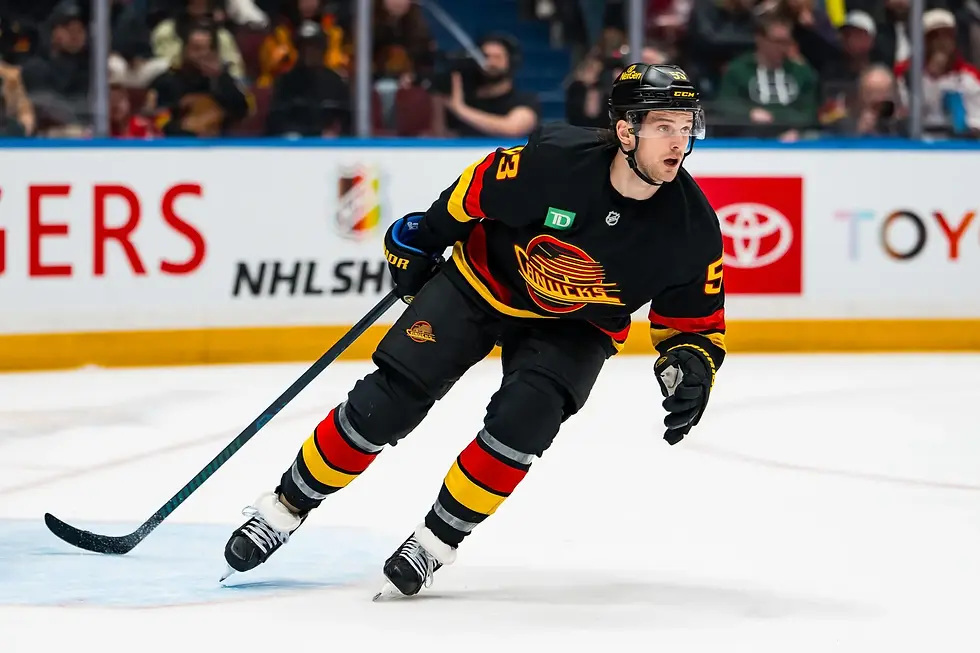
Nils Hoglander: C-
Last year’s rank: C+
GP 38 G 2 A 3 TP 5 +/- (-4)
This was not the season anyone had in mind when the Canucks signed Nils Hoglander to a three-year, $9M deal at $3M AAV back in October 2024. The 25-year-old left winger was supposed to build on back-to-back seasons of 36 and 25 points and cement himself as a legitimate middle-six contributor. Instead, it all unravelled before the season even started.
Hoglander suffered an ankle injury in the very first preseason game, requiring surgery and missing the first 29 games of the regular season. When he finally returned, he couldn't crack the lineup consistently, getting scratched another 15 times. In 38 games, he managed just 2 goals and 3 assists for 5 points, career lows across the board. His shooting percentage cratered to 5.7%, and his average ice time of 11:31 was the lowest of his NHL career. Neither number is encouraging.
The concerning part isn't just the production, it's the trust. Getting scratched 15 times on a team that was clearly in tank mode raises some questions. That said, with two years left at $3M AAV and a roster that is going to look very different next season, Hoglander will have every opportunity to remind everyone what he is capable of. A full, healthy offseason should go a long way.
There is talent here; we've seen it. But at 25, Hoglander isn't as young as he once was, and this was a rough year by any measure. A trade this offseason seems unlikely given how low his value currently sits. The Canucks will simply have to hope a healthy summer translates into a bounce-back season.

Zeev Buium: C+
Last year’s rank: N/A
GP 45 G 3 A 9 TP 12 +/- (-24)
Zeev Buium was the centrepiece of the Quinn Hughes trade, and at just 20 years old, the weight of that label comes with a lot of expectations. Filling the void left by the greatest defenseman in Canucks history was never going to be easy, especially for a rookie switching organizations mid-season with an entire fanbase watching his every move.
He handled it better than most would. The 12th overall pick from the 2024 draft averaged 20:21 a night in Vancouver, top-pairing minutes for a 20-year-old in his first NHL season. His skating is dynamic and separates him from most defenders his age, the kind of effortless mobility that made scouts fall in love with him coming out of Denver. He put up 12 points in 45 games with Vancouver and 14 in 31 with Minnesota, a solid 26-point rookie campaign split across two organizations under difficult circumstances.
The minus-24 stings, but this was a broken team with very little defensive structure, and Buium was asked to eat big minutes in the middle of it all. The growing pains were visible, but so was the ceiling. As the season wore on, he started to gain confidence, looking increasingly dynamic and dangerous in the offensive zone. By the end, you could see why the Canucks targeted him in the Hughes trade.
The season wasn't without its bumps; a facial fracture against Pittsburgh on January 25th cost him six games, but the Olympic break worked in his favour, and he returned playing his best hockey as a Canuck down the stretch.
Contract extension talks are coming this summer, and an eight-year deal could push his AAV north of $8M or even $9M, a massive number for a player with just one NHL season under his belt. Buium finished third in rookie scoring among defensemen, which puts his season in a much more flattering light than the raw numbers suggest. If he fulfills his potential, that contract could end up being a steal. Buium is a core piece of this rebuild and the future of this blue line.

Kevin Lankinen: C-
Last year’s rank: A
GP 47 GAA 3.70 SAV .875 SO 0
What a difference a year makes. Twelve months ago, Kevin Lankinen was the feel-good story of the NHL, an afterthought signing who became the Canucks unquestioned starter and rewrote franchise records along the way. This season was a completely different story.
The numbers are rough. A 3.70 GAA and .875 save percentage are difficult to look at, but anyone who watched this team night after night knows the circumstances. The Canucks were one of the worst defensive teams in the league, surrendering high-danger chances at an alarming rate with very little structure in front of their goalies. Lankinen was no exception to that reality, and grading any goalie on this roster purely by the numbers would be unfair.
That said, there were real concerns beyond just the team in front of him. Lankinen tailed off toward the end of last season and never really found his footing this year. At 30 years old, he is likely a declining asset, and the contract Patrik Allvin handed him last February is starting to look uncomfortable. Five years at $4.5M AAV was always a lot for a goalie whose entire body of work as a starter amounted to one remarkable half-season. Four more years remain on that deal, and with Demko locked up at $8.5M, the Canucks are carrying significant goaltending costs heading into a rebuild.
The contract was the right idea, wrong execution. You needed insurance for Demko, and a shorter deal would have done the same job. Five years at $4.5M AAV is a long commitment for a goalie at 30, though with the cap continuing to rise, the number becomes more palatable over time. Lankinen is probably best suited as a capable backup, but he is being paid like a 1B, and that gap is going to be something the Canucks must manage for the next four years.

Liam Ohgren: B
Last year’s rank: N/A
GP 51 G 8 A 10 TP 18 +/- (-16)
If Zeev Buium was the centrepiece of the Quinn Hughes return, Liam Ohgren was probably the biggest throw-in. The 19th overall pick from the 2022 draft had the pedigree, but his career had been trending in the wrong direction. Three NHL seasons in Minnesota yielded just 7 points in 46 games, and the bust label was starting to feel uncomfortably accurate.
Then he got to Vancouver, and everything changed. At the time of the trade, Ohgren had zero points in 18 games with Minnesota. The difference was opportunity. In Minnesota, Ohgren was averaging just 9:32 of ice time a night, barely enough to get into a rhythm. The Canucks gave him 14:27, and he rewarded them with 18 points in 51 games, a massive jump in production that speaks directly to how much deployment matters for young players. It is a lesson Adam Foote seems reluctant to learn, but in Ohgren's case, the extra ice time paid dividends. A nice buy-low add by Jim Rutherford.
The tools are genuinely impressive. He is big, fast, and strong with a solid release that makes him a legitimate threat when given time and space. Personally, I had no idea what to expect when the trade went down. Consider me pleasantly surprised.
Ohgren has one year left at $866K and will be extension eligible this summer alongside Zeev Buium. He projects as a solid middle-six forward, and at that cap hit, he is one of the better value pieces on this roster. It will be interesting to see if the Canucks get an extension done this summer.

Aatu Raty: B-
Last year’s rank: B
GP 66 G 4 A 10 TP 14 +/- (-4)
Aatu Raty is one of the more interesting players on this roster to evaluate. The 23-year-old Finnish centre doubled his games played from last season, which is a step forward for a player still establishing himself at the NHL level. The problem is that he managed only 3 more points despite playing twice as many games. That's a tough number to look at.
The shooting percentage tells an important story, though. Last season, he shot at an unsustainable 20%, and this year the pendulum swung the other way, crashing down to just 6.2%. The truth almost certainly lies somewhere in between, and a bit of bad luck contributed to the dip. It's worth keeping that context in mind before writing off his offensive game entirely. He also led the team in hits with 165, a reminder that Raty was contributing in plenty of ways that don't show up in the points column.
Where Raty genuinely stands out is in the faceoff circle. He finished sixth in the entire NHL this season at 60.5%, and his career percentage of 59.18% ranks fourth all-time among players with a minimum of 500 draws. That is an elite, legitimate skill that has real value on any roster, and it alone justifies his place in a bottom six. His defensive game was also strong throughout the season, which is exactly what you want to see from a player who projects as a reliable defensive centre.
The area that needs work is his skating. It limits his offensive ceiling, and until he addresses it, he will likely remain a bottom-six piece. This upcoming summer, he will be training in Sweden with the same skating coach who worked with the Sedin twins. Next season is also a contract year for the 23-year-old, so expect him to come in motivated and hungry for minutes. If the skating takes a step forward, the offensive upside could follow.

Max Sasson: B-
Last year’s rank: B
GP 66 G 13 A 6 TP 19 +/- (-13)
Max Sasson had a breakout season. There is really no other way to put it. The 25-year-old went from a depth piece averaging 10:20 a night to one of the more productive forwards on this roster, finishing with 13 goals in 66 games and ranking third on the team in even-strength goals behind only Brock Boeser and Drew O'Connor. Impressive stuff.
The move to the wing unlocked something in his game. Sasson was never going to be an elite faceoff guy, sitting at 42.1% this season, but on the wing, his elite speed becomes a true weapon. Off the rush, he is one of the most dangerous players on this roster. The shooting percentage of 21% is not sustainable, and the 6 assists in 66 games suggest the overall offensive game still has room to grow. But 13 goals is 13 goals, and on a team that struggled to score all season, Sasson was one of the few bright spots.
He signed a two-year extension on December 15th at $1M AAV starting next season, locking him in through 2027-28. At that price, with more room to grow offensively, the Canucks got good value. The speed is elite, the finishing ability is real, and if the playmaking develops to match, Sasson could push for a bigger role over the next two seasons.

Elias N. Pettersson: C+
Last year’s rank: A-
GP 66 G 13 A 6 TP 19 +/- (-13)
Two years into his NHL career, Elias Pettersson is quietly becoming one of the better value picks in recent Canucks draft history. The 22-year-old defenseman out of Sweden was selected 80th overall in 2022, a third-round pick who has now played 98 NHL games before his 23rd birthday. That alone is worth appreciating.
This season was a step forward in terms of availability and role. Pettersson played 70 games, averaged 14:59 a night, and finished second on the team in hits with 136. He brings a physicality and toughness that this roster genuinely lacks, and his presence is felt every shift.
Giveaways and turnovers in his own zone were too frequent this season, and under Foote's system, he was far from alone in that regard. The bigger question is his ceiling. Is there another level here, or does Pettersson max out as a physical, minutes-eating third-pair defender? Put him in a competent defensive system with proper structure around him, and those issues likely improve. The hope is that the best is still to come.
Extension talks could happen this summer, though nothing is certain. The Canucks face an interesting decision here. They could take a swing and sign him long term, betting on further development and locking in a team-friendly number. Or they bridge him, risking that he takes a step forward and prices himself up on his next deal. Either way, the physical tools are there. He is big, fast, and durable, and those point in the right direction. The ceiling question is one only time will answer.

Tom Willander: B-
Last year’s rank: N/A
GP 70 G 5 A 16 TP 21 +/- (-23)
Tom Willander made the jump from Boston University to professional hockey this season and never really looked back. The 11th overall pick from the 2023 draft played 70 NHL games, averaged 16:59 a night, and finished sixth in rookie scoring among defensemen. He did spend five games in Abbotsford early on, but for a 20-year-old in his first professional season, that is an encouraging debut.
Personally, the comparisons to Filip Hronek feel very fitting. Willander is a smooth, confident skater who processes the game quickly and moves the puck with purpose. His five even-strength goals were quietly impressive, more than Jake DeBrusk managed on the season, and his 21 points in 70 games give you a real sense of the offensive upside that made him an 11th overall pick in the first place.
The minus-23 is ugly, but the same caveat applies here as it does to every defenseman on this roster. This was a broken team with very little defensive structure, and Willander was asked to eat meaningful minutes in the middle of it all. Notably, over his final 25 games, he was elevated into a bigger role, averaging over 20 minutes a night at 20:13, a sign the coaching staff liked what they were seeing. Getting stronger this offseason has to be the priority. He gets pushed off pucks too easily at this stage, and adding strength will only sharpen the rest of his game.
Willander is one of the foundational pieces of this rebuild. Alongside Buium, the Canucks have two young right and left-shot defensemen with legitimate top-four upside. The future of this blue line is in good hands.
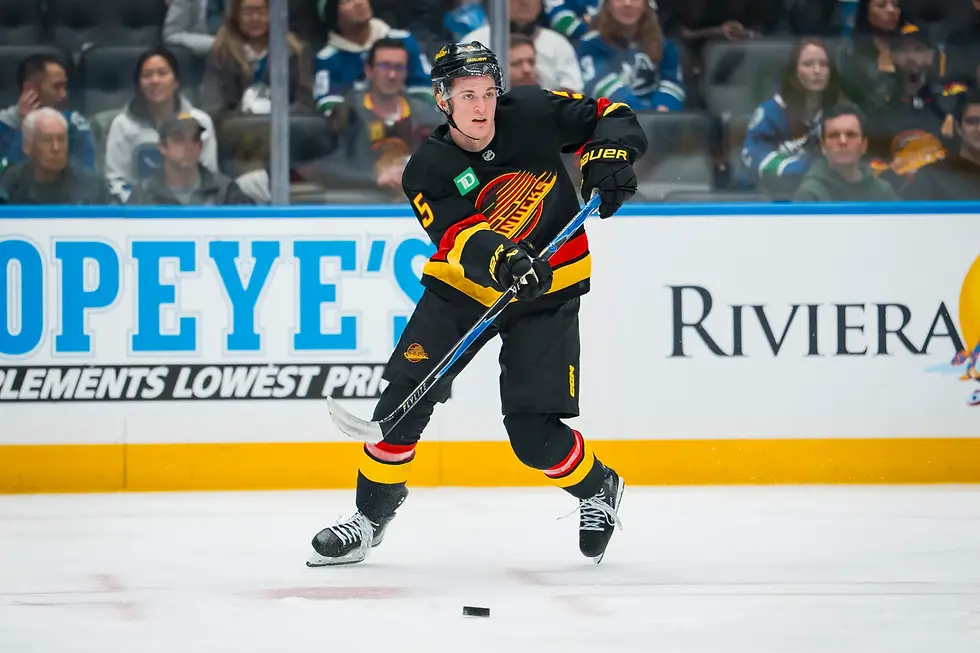
Evander Kane: C
Last year’s rank: N/A
GP 71 G 13 A 18 TP 31 +/- (-20)
Vancouver's own Evander Kane came home this season, acquired from the Edmonton Oilers for a 2025 fourth-round pick just two days before the draft. No salary retention, a player who had missed an entire season with injury, entering his age-34 campaign. At the time, the Canucks were still trying to compete, so the move made a degree of sense, but giving up a mid-round pick with zero retention for a guy coming off a lost season was always a bit of a stretch.
To his credit, Kane showed up and contributed. He finished sixth in team scoring with 31 points in 71 games, which is quietly decent for a player who was much maligned throughout the season. Early on, he looked engaged, physical, and motivated playing in his hometown, but as the season wore on, the cracks started to show. Kane racked up 92 penalty minutes with only two fights in that total, meaning almost all of it was the undisciplined, momentum-killing variety that drives coaches and fans crazy. His physical game faded noticeably, he dealt with multiple injuries, and he missed the final six games of the season. When the Canucks tried to move him at the trade deadline, there were no suitors. That's a pretty telling sign of where his value sits around the league right now.
Ultimately, Kane was a panic move to bolster a forward corps that needed more than one aging power forward could provide. In hindsight, the Canucks would have been far better off re-signing Pius Suter, who walked out the door and signed a two-year deal with St. Louis at $4.125M AAV, younger, cheaper, and far more reliable. Kane will become a UFA this summer, and that will be that. He hit the 1,000 game mark on March 30th in Las Vegas, a milestone worth tipping your cap to. But when you look back at this trade, you gave up a fourth-round pick to bring in an injury-riddled 34-year-old when a better, younger, more versatile player was right there for nothing. That one stings.

Elias Pettersson: C
Last year’s rank: C
GP 74 G 15 A 36 TP 51 +/- (-30)
There is no easy way to write this one. Elias Pettersson is the most polarizing player on the Canucks right now, and another underwhelming season has only deepened that divide. The 27-year-old finished with 51 points in 74 games, a number that would be perfectly acceptable from a middle-six forward. At $11.6M a year, it is not.
The first half of the season showed flashes of the player Vancouver fell in love with, but the second half told a different story entirely. Two goals in his final 36 games is simply unacceptable at any price point, let alone at the highest salary on the roster. His shot volume continues to be a concern, finishing with just 131 shots on goal, well below the 190 per 82 game average his career suggests he should be generating. He needs to shoot more. Full stop.
The decline over the last three seasons is real and hard to ignore. From 102 points in 2022-23 to 89, then 45, and now 51. The trajectory is not encouraging. His skating metrics have declined, his shooting percentage has cratered, and the production has followed. At 27 years old with six years left on his contract at $11.6M AAV, the question of whether a fresh start would be best for both parties is one that is hard to avoid asking.
Is he tradable? That is the real problem. Six years of term with no salary retention appetite from the Canucks makes this an incredibly difficult contract to move. For now, Pettersson remains a Canuck, and the hope is that a proper offseason of rehab and strength work unlocks something heading into next year. The talent is still in there somewhere. For both his sake and the organization's, getting the best out of him has never mattered more.

Brock Boeser: C+
Last year’s rank: C+
GP 75 G 22 A 26 TP 48 +/- (-48)
The biggest storyline surrounding Brock Boeser this offseason was whether he would re-sign at all. After a quiet contract year and an organization that tried to move him at the deadline, many expected him to walk in free agency. Instead, he signed a seven-year, $50.75M extension at $7.25M AAV on July 1st, 2025, with a full no-move clause for the first four years. Whether that turns out to be a great deal or a tough one largely depends on what Boeser does over the next few seasons.
This season was a mixed bag. The minus-48 was the worst plus-minus in the entire NHL this season, but context matters here. Boeser spent stretches of the season centred by David Kampf and Lukas Reichel, both of whom were traded at the deadline, hardly the linemates needed to unlock his offensive game. When he got time alongside Elias Pettersson and Marco Rossi, the production ticked up noticeably. He finished with 22 goals and 48 points in 75 games, which is quietly solid for a guy playing in some difficult situations.
Beyond the numbers, Boeser has quietly become a respected veteran presence in that locker room. That kind of leadership has real value on a team heading into a rebuild with a lot of young players finding their footing.
At $7.25M, the contract looks steep right now, but with the salary cap projected to keep climbing, that number will become more palatable over time. Trading him for futures is an option, but keeping a proven offensive veteran with leadership qualities during a rebuild isn't the worst idea either.

Linus Karlsson: A
Last year’s rank: B-
GP 79 G 15 A 20 TP 35 +/- (-28)
Linus Karlsson is one of the feel-good stories of this season. The 26-year-old Swedish winger came into the year on a one-year, $775K deal with something to prove, and he delivered in a big way. Finishing 10th in rookie scoring with 35 points in 79 games while averaging just 12:31 a night is impressive, and it earned him a two-year extension on January 2nd at $2.25M AAV. A well-deserved pay bump.
What made Karlsson's season stand out wasn't just the points. He is a handful along the boards, strong on pucks in front of the net, and reads the game well. He finished with just 4 power play points, which is frustrating given how capable he is in that role. There was no good reason for Evander Kane to be getting those minutes over him, and that falls squarely on the coaching staff.
The development path here is worth appreciating, too. Karlsson spent years grinding through Abbotsford, quietly improving his game before getting his real shot this season. He is one of the rare success stories from the farm system this year, a player who took his opportunity and ran with it on a team that didn't give many players that chance.
At $2.25M AAV over the next two seasons, he looks like excellent value. Next season could be even more exciting for Karlsson with the potential hire of Manny Malhotra behind the bench. Malhotra coached Abbotsford and won the Calder Cup in 2025, with Karlsson being a key part of that championship team. A coach who already knows his game and believes in him could unlock another level entirely.

Jake DeBrusk: B
Last year’s rank: B
GP 81 G 23 A 19 TP 42 +/- (-31)
Jake DeBrusk had one of the stranger statistical seasons you will see from a 23-goal scorer. Led the team in goals, finished fourth in points, set a career high with 219 shots on goal, and yet managed just 4 even-strength goals all season. He was absolutely lethal on the power play, finishing third in the entire NHL with 19 power-play goals. That is an elite skill that other teams covet, and it only adds to his value. He also closed the season on fire, scoring 9 goals in his final 13 games to finish on an extremely high note.
The underlying numbers are a bit of a puzzle, though. His shooting percentage dropped to 10.5% against a career average of 12.5%, and the even-strength production was alarming for a player of his calibre. Whether that is a product of linemates, deployment, or just variance is hard to say. What is clear is that on the power play, he is a legitimate threat, doing his damage in front of the net by tipping shots and pouncing on rebounds with positioning and timing that is hard to defend.
At $5.5M AAV on a seven-year deal signed July 1st, 2024, his contract is aging quite well. A perennial 20-goal scorer at that price with the cap rising is solid value, and the NMC for the first three seasons means he isn't going anywhere in the short term, unless he wants to.
The question mark heading into next season is whether DeBrusk wants to stick around for a rebuild. He is a proven veteran winger who could help a contender, and there is a real possibility he requests a move down the line. For now, he remains a Canuck, and a productive one at that.

Marcus Pettersson: C
Last year’s rank: B+
GP 82 G 3 A 15 TP 18 +/- (-19)
Marcus Pettersson played all 82 games this season, which is worth acknowledging on a roster that was decimated by injuries all year. The 29-year-old defenseman has never been an offensive driver, and this season was no different, finishing with 18 points in 82 games. At $5.5M, you would at least like to see 20 to 25 points, and he fell short of that. The turnovers, the icings, and the general frustration in his own zone were hard to ignore as well.
Foote's defensive system did nobody any favours on this roster. He is a defensive defenseman by nature, and in a competent system with proper structure around him, many of those issues likely look different. That context matters. What is encouraging is that Pettersson has emerged as one of the leaders in that locker room. That kind of presence has real value on a young team heading into a rebuild.
His contract could become a concern. Five years remaining at $5.5M AAV with a full NMC for two more seasons is a significant commitment for a player whose offensive contributions are limited. With the cap rising, it becomes more manageable over time, but it is still a lot of term for a player entering their thirties. The hope is that a new coaching staff and a better system bring out a more consistent version of Pettersson next season.

Drew O'Connor: B
Last year’s rank: C
GP 82 G 17 A 12 TP 29 +/- (-12)
Not many players on this roster can say they played all 82 games and produced at a career high level. Drew O'Connor can. The 27-year-old winger was one of the few genuinely pleasant surprises on a team that had very little to celebrate, finishing with 17 goals and tying Brock Boeser for the team lead in even-strength goals with 15. Two shorthanded goals on top of that showed he can contribute in all situations.
What made O'Connor's season stand out wasn't just the numbers; it was the consistency. Night after night, he brought the same effort, the same physical presence, and the same willingness to go to the hard areas of the ice. On a roster full of question marks, that kind of reliability was refreshing.
The 12 assists leave something to be desired, and the playmaking side of his game still needs to develop. But 17 goals at $2.5M AAV in the first year of a two-year deal is exactly what the Canucks needed from him. If he can build on this next season, O'Connor becomes a very interesting commodity at the trade deadline for a contender looking to add a physical winger who can score. The Canucks will have a decision to make.

Filip Hronek: A
Last year’s rank: B+
GP 82 G 8 A 41 TP 49 +/- (-23)
Filip Hronek was the best player on this roster this season. While the team around him crumbled, Hronek quietly put together the best individual season of his career, setting career highs in points with 49 and average ice time at 25:00 a night. On a blue line that was decimated by injuries and surrounded by chaos, he was the one constant.
The 41 assists tell the real story. For years, there was a question of how much of Hronek's production was a product of playing alongside Quinn Hughes. This season answered that. Without Hughes in the lineup for the first time, Hronek proved he can drive offence on his own terms, quarterbacking the power play, moving the puck efficiently under pressure, and logging 25 minutes a night on a team that needed him desperately. That is a significant statement.
Six years remain on his eight-year, $58M deal at $7.25M AAV. With the cap rising and the Canucks heading into a rebuild, that contract becomes increasingly valuable. There have been rumblings that the organization considered naming Hronek captain, and while the respect he has earned is undeniable, it just doesn't feel like the right fit. He is not someone who seeks the spotlight, and his relationship with the media reflects that. Lead by example, let someone else do the talking. He is the most valuable piece on this roster.


Comments